

Private sector in jurisdiction of authority: Preparation to give unconstitutional powers to the Constitutional Commission
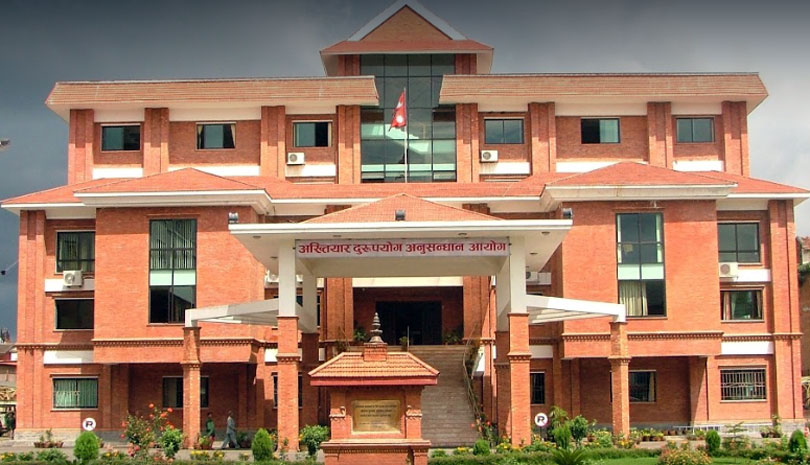 |
| Commission for Investigation of Abuse of Authority |
June 6, Kathmandu. The Commission for Investigation of Abuse of Authority (Third Amendment) Bill under discussion in the Parliamentary Committee states that the private sector will also be brought under the jurisdiction of the Commission.
Article 2 of the Commission for Investigation of Abuse of Authority (CIAA) Act states that the Commission, Committee, Institution, Authority, Corporation, Company, Establishment, Board, Center, Council, Bank, Medical College and any other affiliated institution of similar nature established in accordance with the prevailing law. Is called a 'public institution'. If this bill is passed as it is, the private sector will also fall under the jurisdiction of Adua.
'Unconstitutional rights'
Adua's work, duties and rights are clearly stated in the constitution. According to Article 239 of the Constitution, Adua may, in accordance with the law, conduct an inquiry into the corruption and abuse of power by a person holding a public office.
"Once the constitution says that a person holds a public office, there is no question that the private sector or a person who does not hold a public office falls under the jurisdiction of Adua," he said. Bhimarjun Acharya says, "It is not possible to make a law by keeping what is not in the constitution."
Experts say that even if the bill under consideration related to the Adua Act is passed, it will not be implemented. "Even if the law is made by giving the right to look after the private sector, it will be repealed," said another constitutionalist. Chandrakant Gyawali says, "Any law that is in conflict with the constitution is automatically repealed."
In a country like Nepal that has adopted constitutional supremacy, any unconstitutional act will be unfortunate, say constitutionalists.
Contrary to popular belief and theory The purpose of establishing Adua is to control corruption in the public sector and promote good governance. "In line with the spirit of the constitution, we have adopted a promotional, preventive and punitive strategy to control corruption in the public sector and enhance the rule of law and good governance," Adua's annual report said.
National Assembly member Radheshyam Adhikari, who is also a senior advocate, says that Adua's attention should be focused on preventing the misuse of taxes paid by the people. He said that the government should regulate the private sector as it is a risky sector.
He says it is up to the government to regulate the private sector and take action against those who make mistakes.
Dr. Acharya says that in principle, it would not be appropriate to give Adua the right to investigate the private sector. "Not only constitutionally, but also ideologically and philosophically, it is wrong to give such authority to the authorities," he said.
Fear of abuse
While Adua Commissioner Rajnarayan Pathak was in office, he was arrested on the charge of taking millions of rupees. The then Chief Commissioner of Adua, Lokman Singh Karki, misused Adua for personal EB.
It is enough to remind the reader and Karki to understand that not all the people under the leadership of Adua have pure intentions. It is also clear that not every appointment in Adua has risen above party affiliation.
In such a scenario, experts fear that increasing Adua's jurisdiction will not reduce corruption but increase it. He has said that Adua has 'shaking the small and the disliked and shaking with the big'. He fears that the private sector is trying to bring in a law to 'crack down on the disliked'.
Adua has been accused of failing to exercise her current rights freely, fairly and efficiently. In the fiscal year 2075/07, 83 out of 204 cases were filed by special courts against Adua. Eight thousand 558 cases that could not be disposed of by the commission have been shifted to 076/77.
Government distrusts itself!
The Prime Minister's Office and the Office of the Council of Ministers have drafted the bill and sent it to the parliament so that the private sector can also see Adua. While various organs of the government have the right to investigate and take action on corruption or irregularities in banks, medical colleges, committees or institutions.
For example, there are bodies like Ministry of Finance and Rashtra Bank to regulate banks. Medical colleges can be regulated by Nepal Medical Council, University, Ministry of Education, Ministry of Health.
"It is as if the government has mistrusted itself to say that the irregularities of the private sector cannot be stopped without the authority," he said. Gyawali says, "Letting the authorities see everything also means distrusting the current regulatory body."
If more vigilance is required in monitoring the irregularities of the private sector, it should be started from the public sector. Acharya explains. He says the government has deliberately diverted attention from the private sector amid growing criticism of its inability to control the growing corruption in the public sector.


1 Comments
nice news
ReplyDeleteWrite us a comment for more information.