

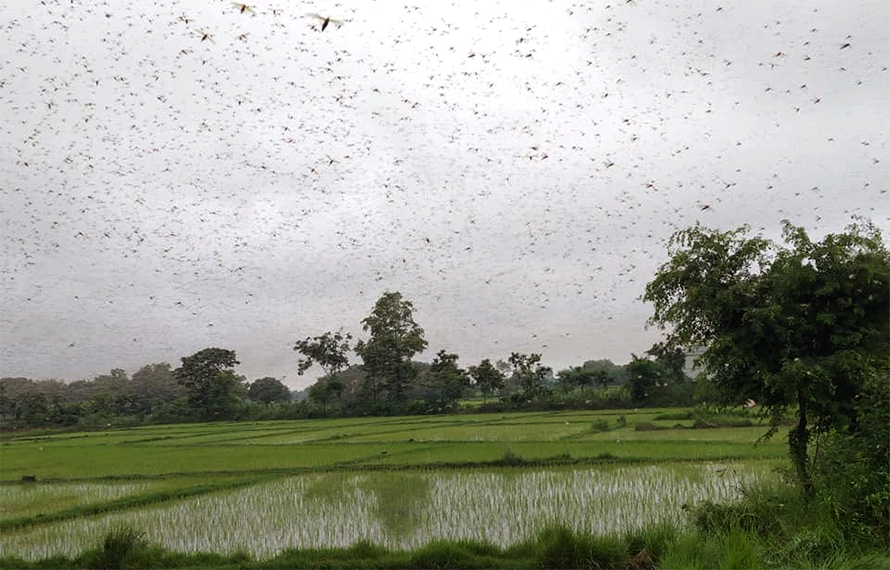
Kathmandu. Locusts have been found in 24 different districts of Nepal. There are locusts in 24 districts till 12 noon on Tuesday, according to the locust information center under the plant quarantine and pesticide management center. The locusts have damaged maize, paddy and banana farms, said Ram Krishna Subedi, chief of the center. Although the damage has not been estimated, the details of locust infestation have come to the notice of the center, he said.
According to the Center, a large swarm of locusts from Bhairahawa, Bara, Parsa and Sarlahi, Makwanpur and Kapilvastu of Rupendehi flew into Nepal on Saturday morning. Where did the locusts reach? There were only two / three thousand locusts in Bara, Parsa, Rautahat and Sarlahi. From there, the locusts are said to have reached the hilly areas to the north.
The number of locusts in Bardiwas and Makwanpurgadhi of Mahottari is not certain and they have migrated to the forest and Sindhuli. Similarly, the center estimates that there are about one million locusts in Bakaya and Hetauda of Makwanpur. According to the Center, some of the locusts found there flew towards Chitwan. Similarly, one lakh locusts were seen in Kalika, Shaktikhor and Ratnanagar in Chitwan on Monday and the locusts have not flown.
Similarly, two to three lakh locusts have been found on the plane of Sindhuli. Some of these numbers have reached the information centers moving towards Kavre and Ramechhap. Similarly, small numbers of locusts have reached Ramechhap, Kavre and Kathmandu Valley. The locusts found here are scattered and in very small quantities. In Kalikanagar, Vutwal and Sainamana of Rupandehi, about 500,000 to 700,000 people have gone to Kapilvastu and Palpa.
The locusts found in a herd of more than 7,000 in Kapilvastu's Banganga on Sunday are scattered. The locusts that reached Palpa on July 29 are in the information center in a herd of around 4 to 5 lakhs. From there, locusts fly to Syangja and Gulmi. Similarly, there are about 50,000 locusts in Kaligandaki of Syangja, 4,000 in Gadhwa of Dang and 4,000 in Tulsipur. A herd of 8 to 1 million has been found in Buddhabhumi, Shivaraj and Kapilvastu municipalities of Kapilvapastu.
According to the Center, a large number of locusts flew northwest towards Dang, Pyuthan and Rolpa. Locusts have been found in a herd of about two lakh in Kaski. A small number of locusts have been found in Gulmi, Pyuthan, Panchthar, Udaipur and Khotang, Kailali. Damage to maize crop in Makwanpur
The center has stated that the newly planted paddy has damaged maize, vegetables and forest greenery due to the locusts. According to the information center, the locusts have damaged maize fields planted in 1,000 ropanis in Bakaya and Hetauda of Makwanpur district. Similarly, in Bara, Parsa, Rautahat and Sarlahi, locusts have only affected nutritious grass farming. Locusts have destroyed vegetables and other crops in Mahottari.
According to the Center, seeds and freshly planted paddy have been damaged in Kalika, Shaktikhor and Ratnanagar of Chitwan. Forests have damaged forests in Sindhuli, some vegetables and maize in Rupandehi, vegetables and paddy in Kapilvastu, some crops and forests in Palpa, Kerakheti in Syangja, paddy planted in Dang, grassland in Kaski and maize in Kailali and forest trees in Kailali.


0 Comments
Write us a comment for more information.